Showing posts with label priesthood. Show all posts

02 April 2015

The Pact of the Catacombs


Shortly before the conclusion of the Second Vatican Council, 40 bishops met on the night of 16 November 1965 in the Domitilla Catacombs outside Rome.  In that holy place of Christian dead they celebrated the Eucharist and signed a document that expressed their personal commitments to the ideals of the Council under the suggestive title of the "Pact of the Catacombs". It also goes by the title "Pact of the Servant and Poor Church". Among the bishops gathered was Dom Helder Camara, Archbishop of Recife, Brazil and icon of justice and freedom in Latin America. The statements' counter-cultural ideals and latent radicalism however might have limited its impact to only a dedicated few. Yet in the ensuing years, the little pact of minority bishops gradually caught fire, inspiring the rise of liberation theology, the orthodoxy of the Church of the poor, and the praxis of building basic ecclesial communities as agents of Gospel-based change in individuals and society in many parts of the world and beyond Catholic circles.
.......

We, bishops assembled in the Second Vatican Council, are conscious of the deficiencies of our lifestyle in terms of evangelical poverty. Motivated by one another in an initiative in which each of us has tried avoid ambition and presumption, we unite with all our brothers in the episcopacy and rely above all on the grace and strength of Our Lord Jesus Christ and on the prayer of the faithful and the priests in our respective dioceses. Placing ourselves in thought and in prayer before the Trinity, the Church of Christ, and all the priests and faithful of our dioceses, with humility and awareness of our weakness, but also with all the determination and all the strength that God desires to grant us by his grace, we commit ourselves to the following:

1.      We will try to live according to the ordinary manner of our people in all that concerns housing, food, means of transport, and related matters. See Matthew 5,3; 6,33ff; 8,20.

2.      We renounce forever the appearance and the substance of wealth, especially in clothing (rich vestments, loud colors) and symbols made of precious metals (these signs should certainly be evangelical). See Mark 6,9; Matthew 10,9-10; Acts 3.6 (Neither silver nor gold).

3.      We will not possess in our own names any properties or other goods, nor will we have bank accounts or the like. If it is necessary to possess something, we will place everything in the name of the diocese or of social or charitable works. See Matthew 6,19-21; Luke 12,33-34.

4.      As far as possible we will entrust the financial and material running of our diocese to a commission of competent lay persons who are aware of their apostolic role, so that we can be less administrators and more pastors and apostles. See Matthew 10,8; Acts 6,1-7.

5.      We do not want to be addressed verbally or in writing with names and titles that express prominence and power (such as Eminence, Excellency, Lordship). We prefer to be called by the evangelical name of "Father." See Matthew 20,25-28; 23,6-11; John 13,12-15).

6.      In our communications and social relations we will avoid everything that may appear as a concession of privilege, prominence, or even preference to the wealthy and the powerful (for example, in religious services or by way of banquet invitations offered or accepted). See Luke 13,12-14; 1 Corinthians 9,14-19.

7.      Likewise we will avoid favoring or fostering the vanity of anyone at the moment of seeking or acknowledging aid or for any other reason. We will invite our faithful to consider their donations as a normal way of participating in worship, in the apostolate, and in social action. See Matthew 6,2-4; Luke 15,9-13; 2 Corinthians 12,4.

8.      We will give whatever is needed in terms of our time, our reflection, our heart, our means, etc., to the apostolic and pastoral service of workers and labor groups and to those who are economically weak and disadvantaged, without allowing that to detract from the welfare of other persons or groups of the diocese. We will support lay people, religious, deacons, and priests whom the Lord calls to evangelize the poor and the workers by sharing their lives and their labors. See Luke 4,18-19; Mark 6,4; Matthew 11,4-5; Acts 18,3-4; 20,33-35; 1 Corinthians 4,12; 9,1-27.

9.      Conscious of the requirements of justice and charity and of their mutual relatedness, we will seek to transform our works of welfare into social works based on charity and justice, so that they take all persons into account, as a humble service to the responsible public agencies. See Matthew 25,31-46; Luke 13,12-14; 13,33-34.

10.  We will do everything possible so that those responsible for our governments and our public services establish and enforce the laws, social structures, and institutions that are necessary for justice, equality, and the integral, harmonious development of the whole person and of all persons, and thus for the advent of a new social order, worthy of the children of God. See Acts 2,44-45; 4;32-35; 5,4; 2 Corinthians 8 and 9; 1 Timothy 5,16.

11.  Since the collegiality of the bishops finds its supreme evangelical realization in jointly serving the two-thirds of humanity who live in physical, cultural, and moral misery, we commit ourselves: a) to support as far as possible the most urgent projects of the episcopacies of the poor nations; and b) to request jointly, at the level of international organisms, the adoption of economic and cultural structures which, instead of producing poor nations in an ever richer world, make it possible for the poor majorities to free themselves from their wretchedness. We will do all this even as we bear witness to the gospel, after the example of Pope Paul VI at the United Nations.

12.  We commit ourselves to sharing our lives in pastoral charity with our brothers and sisters in Christ, priests, religious, and laity, so that our ministry constitutes a true service. Accordingly, we will make an effort to "review our lives" with them; we will seek collaborators in ministry so that we can be animators according to the Spirit rather than dominators according to the world; we will try be make ourselves as humanly present and welcoming as possible; and we will show ourselves to be open to all, no matter what their beliefs. See Mark 8,34-35; Acts 6,1-7; 1 Timothy 3,8-10.

13.  When we return to our dioceses, we will make these resolutions known to our diocesan priests and ask them to assist us with their comprehension, their collaboration, and their prayers.

May God help us to be faithful.


17 February 2011

GOMBURZA


Ang ika-17 ng Pebrero ay araw ng paggunita sa pagpaslang sa tatlong paring martir ng pamahalaang Kastila sa parehong araw noong 1872. Nasa talaan ng mga bayani ng bayan at mga martir ng Simbahan ang kanilang pangalan magpakailanman.

       Pde. Mariano Gomez
       Pde. Jose Burgos
       Pde. Jacinto Zamora

Ang ika-17 ng Pebrero ay araw ng pagtanaw ng utang na loob sa sakripisyo ng GomBurZa para sa katarungan, at kanilang pagtanghal sa kadakilaan ng kapariang Pilipino sa harap ng mga panganib at pagsubok, sa loob at labas ng kanilang mga sarili.

Ang ika-17 ng Pebrero ay araw ng pasasalamat sa inspirasyon ng kanilang kabayanihan, dahil sa GomBurZa naisulat ni Rizal ang El Filibusterismo, dahil sa kanila mas umigting ang pagnanasa ng kalayaan sa diwang Pilipino, dahil sa kanila mas yumabong ang pagkakakilala ko sa pagkatao at ministeryo ng isang paring Pilipino.

11 June 2010

On Being Priest

Thoughts on the Feast of the Sacred Heart
and the Closing of the Year for Priests


“Love means to learn to look at yourself
The way one looks at distant things
For you are only one thing among many.
And whoever sees that way heals his heart,
Without knowing it, from various ills—
A bird and a tree say to him: Friend.

Then he wants to use himself and things
So that they stand in the glow of ripeness.
It doesn’t matter whether he knows what he serves:
Who serves best doesn’t always understand.”


Czeslaw Milosz, “Love”


As the Year for Priests ends, of all the texts and thoughts pondered and prayed over during the year, the poem above, for me at least, says the most about the priesthood: its optimism, its issues, and its future.

16 May 2010

Act of Entrustment and Consecration of Priests and Religious to Our Lady of Fatima

On 12 May 2010, shortly after arriving in Fatima, during his pastoral visit to Portugal and within the Year for Priests, Pope Benedict XVI consecrated and entrusted the global presbyterate to the protection of the Madonna of the Cova.


Immaculate Mother,
in this place of grace,
called together by the love of your Son Jesus
the Eternal High Priest, we,
sons in the Son and his priests,
consecrate ourselves to your maternal Heart,
in order to carry out faithfully the Father’s Will.

We are mindful that, without Jesus,
we can do nothing good (cf. Jn 15:5)
and that only through him, with him and in him,
will we be instruments of salvation
for the world.

Bride of the Holy Spirit,
obtain for us the inestimable gift
of transformation in Christ.
Through the same power of the Spirit that
overshadowed you,
making you the Mother of the Saviour,
help us to bring Christ your Son
to birth in ourselves too.
May the Church
be thus renewed by priests who are holy,
priests transfigured by the grace of him
who makes all things new.

Mother of Mercy,
it was your Son Jesus who called us
to become like him:
light of the world and salt of the earth
(cf. Mt 5:13-14).

Help us,
through your powerful intercession,
never to fall short of this sublime vocation,
nor to give way to our selfishness,
to the allurements of the world
and to the wiles of the Evil One.

Preserve us with your purity,
guard us with your humility
and enfold us with your maternal love
that is reflected in so many souls
consecrated to you,
who have become for us
true spiritual mothers.

Mother of the Church,
we priests want to be pastors
who do not feed themselves
but rather give themselves to God for their brethren,
finding their happiness in this.
Not only with words, but with our lives,
we want to repeat humbly,
day after day,
Our “here I am”.

Guided by you,
we want to be Apostles
of Divine Mercy,
glad to celebrate every day
the Holy Sacrifice of the Altar
and to offer to those who request it
the sacrament of Reconciliation.

Advocate and Mediatrix of grace,
you who are fully immersed
in the one universal mediation of Christ,
invoke upon us, from God,
a heart completely renewed
that loves God with all its strength
and serves mankind as you did.

Repeat to the Lord
your efficacious word:
“They have no wine” (Jn 2:3),
so that the Father and the Son will send upon us
a new outpouring of
the Holy Spirit.
Full of wonder and gratitude
at your continuing presence in our midst,
in the name of all priests
I too want to cry out:
“Why is this granted me,
that the mother of my Lord should come to me?” (Lk 1:43).

Our Mother for all time,
do not tire of “visiting us”,
consoling us, sustaining us.
Come to our aid
and deliver us from every danger
that threatens us.
With this act of entrustment and consecration,
we wish to welcome you
more deeply, more radically,
for ever and totally
into our human and priestly lives.

Let your presence cause new blooms to burst forth
in the desert of our loneliness,
let it cause the sun to shine on our darkness,
let it restore calm after the tempest,
so that all mankind shall see the salvation
of the Lord,
who has the name and the face of Jesus,
who is reflected in our hearts,
for ever united to yours!
Amen!


...
original article found here:
http://www.radiovaticana.org/en1/Articolo.asp?c=392401
http://whispersintheloggia.blogspot.com/2010/05/may-church-be-renewed-by-priests-who.html

02 November 2006

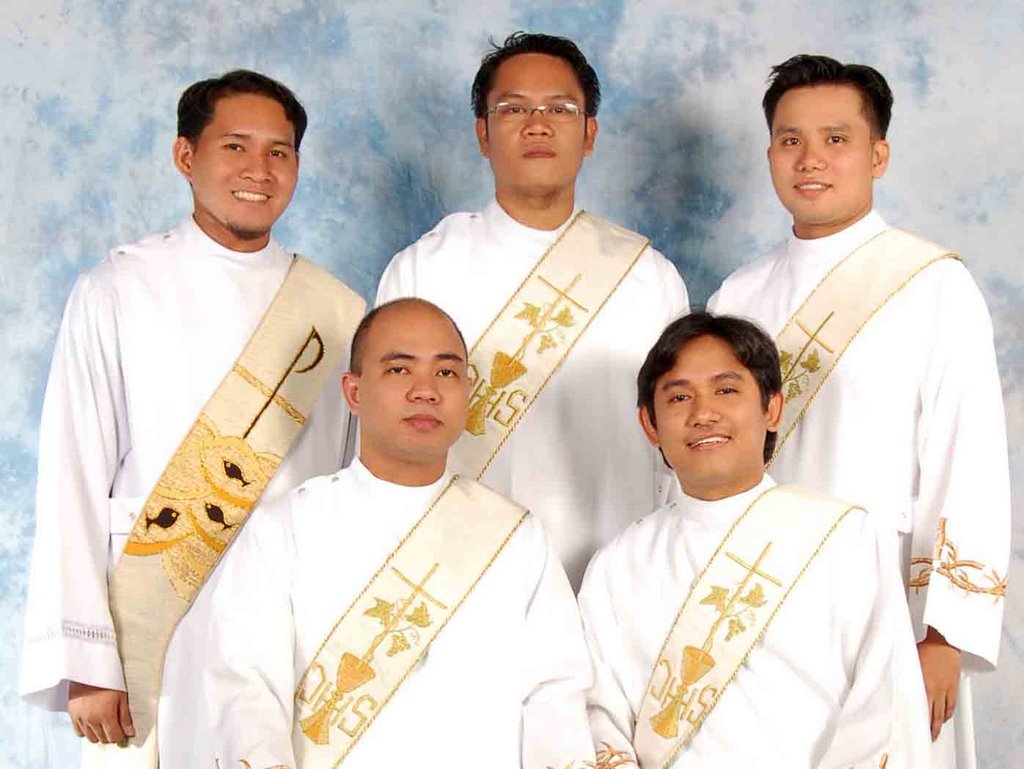
this is your invitation to our ordination

This is your invitation to our Ordination
to the Sacred Order of Presbyters
by the grace of God and the laying on
of hands of our bishop. That day
will be rife with meaning and filled
with possibilities; timely, too, for
celebrating the kindness of friends
and family who helped made that day
possible. We hope you can join us
in the Eucharist and Ordination Rite
at 8:30 a.m., 8 December 2006, Friday,
Solemnity of the Immaculate Conception,

at the Cathedral of St. Gregory the Great
in Legazpi City, and share in the joy
of that day with us, dream dreams
for the Church with us, and pray
that we remain thankfully, faithfully
Shepherds after His own heart.


"I give you shepherds after my own heart." Jeremiah 3,15


Rev. Rex Paul Arjona y Bragais
son of Renato Arjona Sr. and Socorro Bragais
Thanksgiving Mass: 8 December 2006, 4:00 p.m.
St. John the Baptist Parish, Tabaco City

Rev. Gerard Arroyo y Bonayon
son of Simeon Arroyo and Corazon Bonayon
Thanksgiving Mass: 10 December 2006, 3:00 p.m.
St. Anthony of Padua Parish, San Antonio, Tabaco City

Rev. Emman Avila y Belchez
son of Armingol Avila and Evangeline Belchez
Thanksgiving Mass: 9 December 2006, 9:00 a.m.
Our Lady of Mount Carmel Parish, Malilipot

Rev. Jose Baranda Jr. y Benasa
son of Jose Baranda Sr. and Rose Benasa
Thanksgiving Mass: 10 December 2006, 9:00 a.m.
St. Rose of Lima Parish, Bacacay

Rev. Roque Patanao y Oliquiano
son of Segundino Patanao and Delia Oliquiano
Thanksgiving Mass: 9 December 2006, 3:00 p.m.
St. Stephen Proto-Martyr Parish, Ligao City


ORDAINING PRELATE
Most Rev. Nestor C. Cariño, D.D.
Bishop of Legazpi

together with
Most Rev. Lucilo B. Quiambao, D.D.Auxiliary Bishop of Legazpi

Most Rev. Jose C. Sorra, D.D.
Bishop-Emeritus of Legazpi

and the Presbyterium of the Diocese of Legazpi